

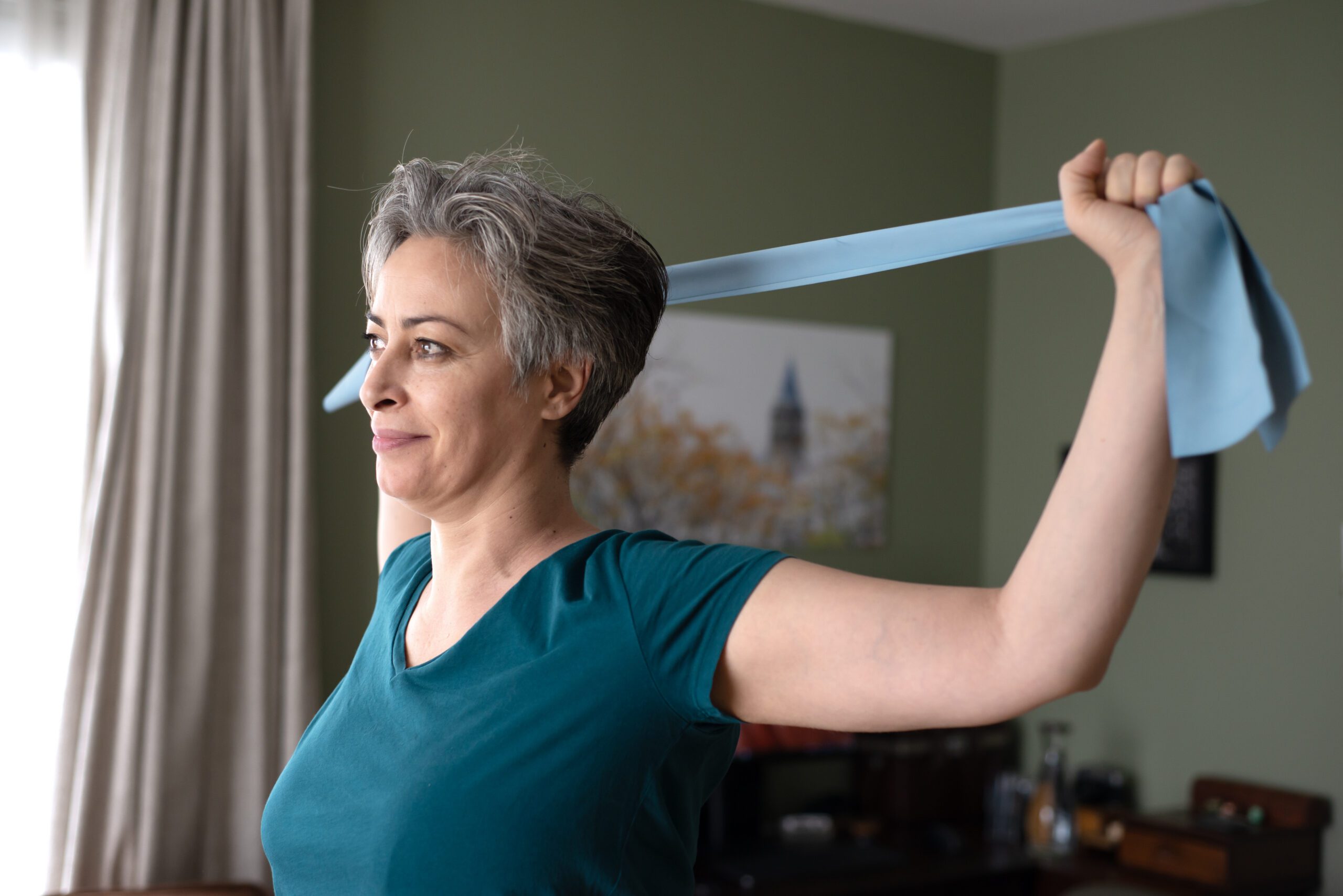
If you’ve ever dealt with a frozen shoulder, you know how frustrating the stiffness and pain can be. When the capsule around the shoulder joint thickens, tightens, or becomes inflamed, movement gets restricted – or “frozen.” In addition to limited mobility, symptoms include stiffness and a dull, aching pain that often worsens at night.
According to UCSF Health, 5–20% of Americans will experience frozen shoulder, particularly individuals whose shoulders have been immobilized after injuries or surgeries, or who have conditions such as thyroid problems, diabetes, heart disease, or Parkinson’s disease. Frozen shoulder tends to affect adults aged 40–60, and it’s more common in women.
While a frozen shoulder often improves on its own, recovery can take up to two years. The good news? Consistent exercise can help speed things up. Airrosti Provider Dr. Jenay Zelaya, DC explains:
“Consistent exercise is key in managing frozen shoulder pain because it helps improve mobility, reduce stiffness, and build strength to better support your body. Here are some exercises to help improve shoulder flexion and retain your range of motion.”
What Is Frozen Shoulder?
Frozen shoulder (also called adhesive capsulitis) occurs when the connective tissue surrounding the shoulder joint becomes inflamed, thickened, and tight — restricting movement and causing pain. The condition typically progresses through three stages:
- Freezing — Pain increases and range of motion begins to decrease.
- Frozen — Pain may ease, but stiffness and limited mobility persist.
- Thawing — Range of motion gradually returns.
Frozen shoulder most often affects adults aged 40–60, particularly women, and is more common among people with diabetes, thyroid disorders, or a history of shoulder immobilization.
Before You Start:
We recommend warming up your shoulder for 10–15 minutes before stretching. A warm shower, bath, or heating pad works well. Remember to stretch to the point of mild tension, not pain.
1. Pendulum Swings: Gentle Warm-Up for Shoulder Mobility
Perform this exercise first. It helps move the shoulder gently while avoiding strain. Be sure to relax your shoulders before you begin.
- Stand next to a table with your chest in line with the edge. Place the hand of your unaffected arm on the table.
- Lean forward slightly, allowing your affected arm to hang down. Keep your hand and elbow in line with your shoulder.
- With your fingers pointing down, gently swing your arm in small circles (about one foot in diameter).
- Swing 10 times to the left and 10 times to the right each day.
- As your range of motion improves, you can widen the circles — but never force the movement.
2. Towel Stretch: Improve Internal Rotation
- Stand up straight.
- Use your unaffected arm to hold a towel behind your back, draping it over your unaffected shoulder.
- Reach behind your back with your affected arm and grab the bottom end of the towel.
- Use your top hand to gently pull the towel straight up to create tension. You should feel a stretch in the affected shoulder.
- Hold the stretch for 15–30 seconds, then relax.
- Repeat 10–20 times.
- Switch arms and repeat on the other side.
- Perform the exercise on each side 3 times a day.
3. Table Slides: Increase Forward Reach and Flexion
- Sit facing a table with your chest in line with the edge. Rest your affected arm on a towel or cloth to promote smooth movement.
- Keep your hand and elbow in line with your shoulder, directly in front of you.
- Gently slide your hand forward across the table.
- Deepen the stretch by leaning your body back, only going as far as comfortable.
- Slowly move your arm back to the starting position.
- Repeat 10 times. Aim to do this 2–3 times daily.
4. Wall Walks: Build Range of Motion in Flexion and Abduction
Flexion
- Stand facing a wall.
- Walk the fingers of your affected arm up the wall until you feel a stretch. (Don’t hunch your shoulders, rise onto your toes, or lean your body as your arm gets higher.)
- Hold for 10 seconds, then slowly walk your fingers back to the starting position. Try to reach a little higher each day.
- Repeat 10 times.
Abduction
- Stand with your body turned 45° away from a wall.
- With your affected arm closest to the wall, walk your fingers up the wall until you feel a stretch. (Don’t hunch your shoulders, rise onto your toes, or lean your body as your arm gets higher.)
- Hold for 10 seconds, then slowly walk your fingers back to the starting position. Try to reach a little higher each day.
- Repeat 10 times.
5. PVC Pipe Stretch: Assisted Flexion and Abduction
Flexion
- Stand with your feet a little more than shoulder-width apart.
- Slightly bend your knees.
- Place the end of a PVC pipe on the ground at arm’s length in front of you.
- Hold the PVC pipe with both hands slightly above waist level.
- If starting with your left shoulder, your left hand should be above your right hand, holding the PVC pipe at eye level.
- Hinge at the hips and press your chest down until you feel tension and stretching in the left shoulder.
- Keep your arms extended and pull your shoulder blades onto your back.
- Hold the position for 10–30 seconds, then switch to the right shoulder. After one interval, switch back to the left.
- Repeat each side 3–5 times.
Abduction
- Hold the PVC pipe in front of you with both hands, palms facing forward.
- Keep your elbows straight.
- Using your unaffected arm, elevate your affected arm up to 90 degrees.
- Hold this position for 5–10 seconds.
- Repeat 10 times.
Quick Recap: 5 Exercises for Frozen Shoulder
- Pendulum Swings — Gentle circles to warm up the joint without strain.
- Towel Stretch — Improve internal rotation using your unaffected arm.
- Table Slides — Increase forward flexion by sliding on a flat surface.
- Wall Walks — Gradually build overhead reach and abduction.
- PVC Pipe Stretch — Assisted flexion and abduction with controlled resistance.
This information is for general educational purposes only. Please speak with your healthcare provider before making any adjustments to your care plan.
Read our Medical Disclaimer here.
Frequently Asked Questions
How long does it take for a frozen shoulder to heal?
Recovery timelines vary, but a frozen shoulder can take anywhere from several months to two years to fully resolve. Consistent stretching and exercise can help speed up recovery.
Can I exercise with a frozen shoulder?
Yes! Gentle stretching and mobility exercises are one of the most effective treatments for frozen shoulder. Always warm up before exercising and stop if you feel sharp pain.
When should I see a doctor for frozen shoulder?
If your symptoms don’t improve after several weeks of consistent exercise, or if pain worsens, it’s time to see a healthcare provider. Airrosti Providers specialize in treating musculoskeletal conditions like frozen shoulder directly at the source.
What causes frozen shoulder?
Frozen shoulder happens when the capsule surrounding the shoulder joint thickens and tightens. Risk factors include prolonged immobilization, diabetes, thyroid disorders, heart disease, and Parkinson’s disease.
Still Struggling with Frozen Shoulder Pain?
If your shoulder pain isn’t improving with exercise, it may be time to see a healthcare provider. Airrosti Providers are trained to pinpoint the root cause of your shoulder pain and treat it directly at its source through targeted manual therapy and customized exercises.
Your Provider will create a personalized treatment plan designed to get you back to the activities you love. Schedule below or call us at (800) 404-6050 for more information.