

You’ve had an amazing vacation week. You learned how to water ski without falling off, found the courage to parasail 400 feet above water, and you finally finished that 400-page beach read. But now you’re back home after flying across three time zones and you…are…tired. Your body aches from fatigue, you can’t concentrate, and ironically, you can’t fall asleep despite dreaming of dreaming. You’ve got jet lag.
Jet lag occurs when we’ve traveled quickly across multiple time zones. The body’s internal clock, the suprachiasmatic nucleus (SCN), cannot adjust as rapidly to the light-dark cycle of the new location, remaining in sync with the previous location. Based on environmental cues, the SCN orchestrates the body’s circadian rhythm (CR), the 24-hour cycle that regulates many bodily functions. Until the internal clock realigns, you may have cognitive, mood, and sleep disturbances. The good news is that jet lag is a temporary circadian rhythm disorder that usually resolves within a few days, but ongoing circadian rhythm disruption over time does more than affect sleep. Research links it to problems in muscles, tendons, cartilage, and bones, along with other long-term health risks.
How Systems Must Align to Keep Running Fine
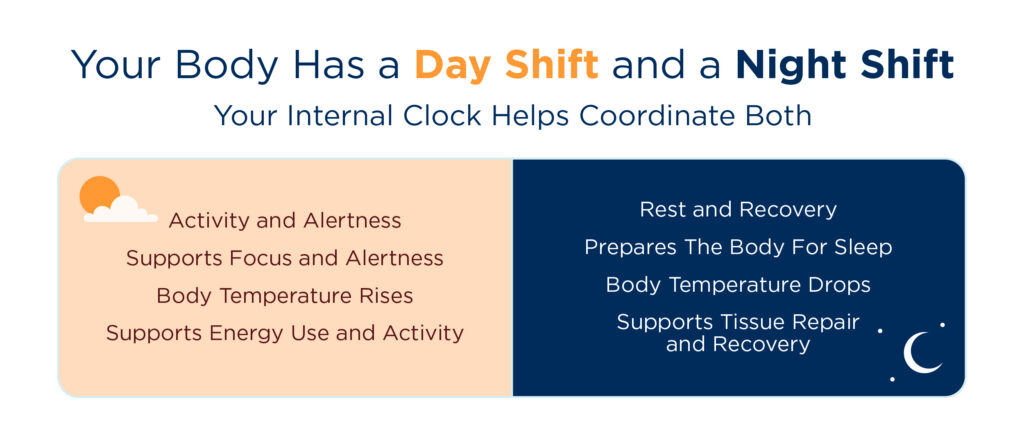
Most circadian rhythm disorders are known to affect your body’s natural sleep-wake cycle, but the functionality of almost every physiological system in our bodies relies on the SCN’s reaction to light and darkness. Based on exposure, the SCN sends signals that determine the body’s circadian rhythm.
- Exposure to light
- Melatonin, the hormone that signals sleep, is suppressed to keep the body awake
- Cortisol, the hormone that keeps the body alert, rises to increase energy, heart rate, and alertness
- Core body temperatures rise to support physical activity while the central nervous system triggers sweating to avoid overheating
- Serotonin increases to enhance focus and mood
- Blood pressure, insulin sensitivity, and digestive rhythms align to support appetite
- Exposure to darkness
- Melatonin is released to cue the body that it’s bedtime
- Cortisol and adrenaline hormones decrease so the nervous system can relax and transition into a restorative state
- The brain clears out metabolic waste, reduces neural activity, and decreases cognitive arousal to consolidate sleep
- The digestive system shifts energy from active nutrient absorption to cellular maintenance and tissue repair
- Human growth hormone is released to repair muscles, regenerate tissues, and support bone growth
- Core body temperature decreases to initiate deep sleep cycles
- Heart rate and blood pressure decrease to help the cardiovascular system rest
Circadian Rythmn Affects More Than Sleep Alone, Harming Muscle, Cartilage, Tendons, and Bone
Disrupted circadian rhythms do far more than make us count sheep or fall asleep at our desks. Did you know research has linked poor circadian rhythms to harm in our soft tissues and bones, and to many musculoskeletal disorders? Here are just a few effects associated with disrupted CRs:
- Bones
- Bone remodeling, the cycle of breaking down old bone tissue to be replaced by new tissue outpaces bone formation, causing bone loss
- Bone metabolism regulates mineral balance, repairs damage, and maintains skeletal strength. Shifted rhythms of cortisol and melatonin accelerate mineral loss and impair cells that build bones
- Bone density is compromised from disrupted signals that block minerals from depositing directly into the skeletal matrix
- Muscles
- The muscle rebuilding process slows down, and the breakdown process accelerates, making it difficult to create muscle mass
- While muscle mass accounts for more than 40% of human body mass CR disruption is linked to skeletal muscle atrophy, the process of active muscle loss
- Muscle cells stop responding to insulin which impedes the body from processing carbs and properly storing energy
- Dedicated stem cells designed to repair a muscle’s micro-tears are stalled. Soreness and recovery times become much longer
- Cartilage
- Proteins go into overdrive, slicing through collagen, the building block that gives cartilage structure. The body cannot rebuild tissue as quickly as the proteins destroy it, causing joint cushions to wear down first
- Key genes inside cartilage turn off, stripping joints of their ability to heal micro-damage
- Inflammatory chemicals increase, damaging joint lining and cartilage over time
- Tendons
- Primarily made of collagen fibers, tendons are unable to build as collagen becomes unavailable or disorganized
- Tendons become stiff, inflexible, and weak when poor CR creates an accumulation of damaged proteins and altered hydration levels within the tissue matrix
- With a compromised repair process, the risk of tendinitis or tendinopathy greatly increases
With so many potential effects on the musculoskeletal system, scientists began to explore the link between CR disruption and musculoskeletal disorders. A study from the Journal of Orthopaedic Translation found that poor CR can uncouple the body’s internal clock from the self-regulating processes of local tissues, allowing several critical mechanisms to break down. This breakdown is associated with disorders such as:
- MSK Disorders
- Osteoporosis (bone thinning)
- Sarcopenia (muscle mass and function loss)
- Osteoarthritis (joint degradation)
- Tendinopathy (tendon degeneration)
- Rheumatoid arthritis (joint stiffness, pain, and chronic inflammation)
When the Internal Clock Gets Set Back, Here are Ways to Get on Track!
Researchers have studied the effects of time shifts for decades, but the discovery that muscle, cartilage, and tendons run on their own circadian clocks is much more recent. By understanding the effects of circadian rhythm, we can better manage or even prevent disruption to our bodies:
- Light Management
- Because morning sunlight helps signal your body to wake up, aim to get 10-30 minutes of sunlight within an hour of waking up to promote alertness
- The sun contains blue light wavelengths that improve mood and cognitive performance; however, blue light from TVs, computers, and phones can convince the brain it’s still daytime, stalling the release of melatonin. Limit exposure to artificial blue lights 2-3 hours before bedtime
- Sleep in complete darkness or wear a sleep mask to ensure maximum melatonin release
- Routine Consistency
- Go to bed in a cool, quiet environment and wake up at the same time every day to anchor your sleep cycle. Keep naps short or skip them
- Exercise during the morning or afternoon when body temperature and muscle efficiency are at their best, producing a stimulatory effect
- Avoid exercise 2-3 hours before bedtime to allow body temperature, adrenaline levels, and heart rate to drop
- Food and Liquid Consumption
- Eat meals at consistent times daily
- Stop eating 3 hours prior to bedtime and avoid night-time snacks to prevent metabolic confusion during sleep
- Do not consume caffeine for at least 8 hours before bedtime. Healthline reports late caffeine can reduce sleep time by 45 minutes
- A study from Current Opinion in Psychology advises avoiding alcohol in the evening as it triggers insomnia, affects breathing, slows melatonin production, and creates oxygen desaturation
- Try to use the bathroom right before bed and do not drink any fluids 1-2 hours before bedtime to avoid getting up at night
This information is for general educational purposes only. Please speak with your healthcare provider before making any adjustments to your care plan.
Aches and Pains Keeping You Up at Night? We’re Here to Help
If muscle aches, joint pain, or stiffness are making it harder to rest, Airrosti can help. Our providers offer a comprehensive evaluation and treatment plan using hands-on manual therapy and guided exercises to relieve pain and get you moving comfortably again, so you can focus on getting the sleep your body needs. We offer in-clinic and telehealth appointments. Schedule below or call us at (800) 404-6050 for more information!